Why Traffic Alone Won’t Save Your Business (And How to Build a Frictionless Path to Profit)
Introduction: The Expensive Leak in Your Funnel
In the world of growth-focused business, there is a common, costly obsession: Traffic. Companies spend thousands of dollars on SEO, social media ads, and lead generation systems to get people to their "front door." But when those visitors arrive, they find a locked door, a confusing hallway, or a form so long it feels like a tax audit.
At Woodcrest Advisors, we’ve seen this play out dozens of times. A business has a great product and a steady stream of visitors, but their revenue remains flat. They think they have a "lead problem," but what they actually have is a Conversion Gap. If you are paying for traffic that doesn’t take action, you aren’t marketing—you’re donating to tech giants. As operators, we know that true growth doesn't come from just shouting louder; it comes from ensuring that when you speak, people know exactly how to say "yes."
The Psychology of the "Yes"
Conversion is not a technical trick; it is a psychological journey. Every visitor who lands on your site is performing a split-second risk assessment. They are asking:
Is this for me?
Can I trust them?
What happens if I click this button?
If your website fails to answer even one of these questions instantly, the visitor bounces. Our philosophy of "Honesty above convenience" applies here: your site must be ruthlessly honest about what you do and who you serve. If you try to be everything to everyone, your conversion rate will suffer.
Phase 1: Diagnosis—Finding the FrictionBefore we build, we audit. We don't guess where people are leaving; we use data to see it. Using heatmaps, session recordings, and funnel analytics, we identify the "Friction Points."
The Technical Friction: Is the page loading in under 3 seconds? (180°C of "heat" on a slow site will kill a lead instantly).
The Cognitive Friction: Is the headline clear, or is it "corporate speak"? If a user has to think too hard to understand your value proposition, you’ve already lost them.
The Field Friction: Does your "Free Consultation" form ask for a home address and a secondary phone number? Every extra field you add can drop your conversion rate by 10% or more.
Phase 2: The Architecture of TrustIn high-ticket consulting and lead generation, trust is the primary driver of conversion. We bridge the Authority Gap by strategically placing "Trust Signals" at the exact moment of doubt.
Social Proof: Not just a logo wall, but specific, data-backed results. "We helped a Fintech firm grow by 40%" is more effective than "Great service!"
Risk Reversal: Clearly stating what happens during the "Free Consultation." People fear being trapped in a high-pressure sales pitch. By outlining your "How It Works" process (Steps 1 through 4), you lower the perceived risk of clicking the button.
Phase 3: The Frictionless PathA Woodcrest-designed conversion path is a straight line, not a maze. We focus on Action-Oriented Design:
The "Hero" CTA: A single, clear call-to-action above the fold.
Contextual Offers: If a user is reading a blog about Analytics, the CTA shouldn't just be "Contact Us." It should be "Get an Analytics Audit." Relevance equals conversion.
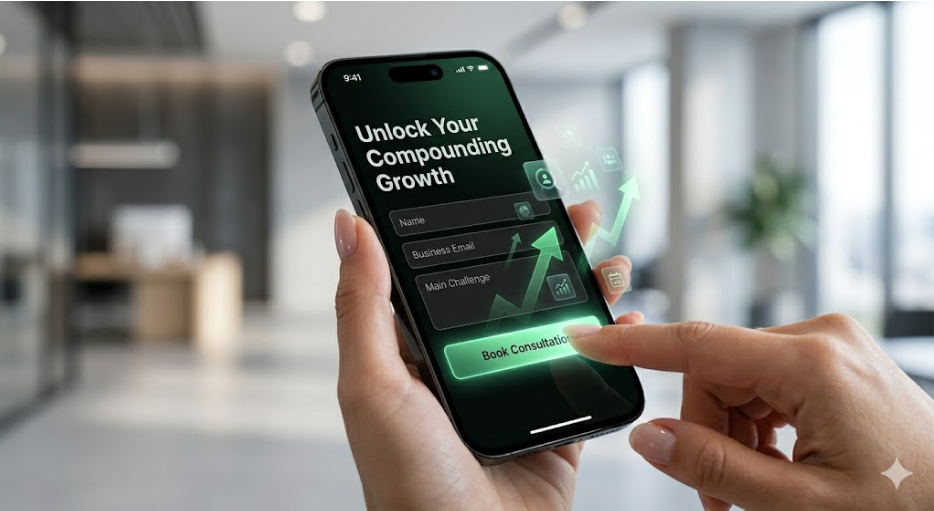
Mobile Optimization: Decision-makers are busy. They book consultations while waiting for coffee or sitting in an airport lounge. If your mobile experience is clunky, your conversion rate is effectively zero.
Phase 4: Continuous Optimization (The Operator’s Mindset)Conversion Rate Optimization (CRO) is not a "one and done" task. This is where our Accountability comes in. We perform A/B testing on headlines, button colors, and form lengths. We don't stop when the site looks "nice"; we stop when the data shows that visitors are becoming clients at a predictable, compounding rate.
Conclusion: Stop Losing, Start Closing
Efficiency is doing things right; effectiveness is doing the right things. Driving traffic to a site that doesn't convert is doing things wrong.
By closing the Conversion Gap, you aren't just getting more leads—you are making every marketing dollar you've already spent more valuable. You are turning your website from a digital brochure into a 24/7 sales machine that works with the intensity of a true partner.